Draft 1
Draft 2
Draft 3
Rationale for the Inquiry
Lacking prior experience in typeface design, I opted to eschew digital software in favor of investigating the discipline’s absolute historical foundations.
In my first tutorial, Zarna asked me why I chose stone carving over digital software, aside from just the historical aspect. I told her that working on a computer feels like designing a typeface, but stone carving is different, it allows me to physically experience the process of a typeface being created from the very beginning.
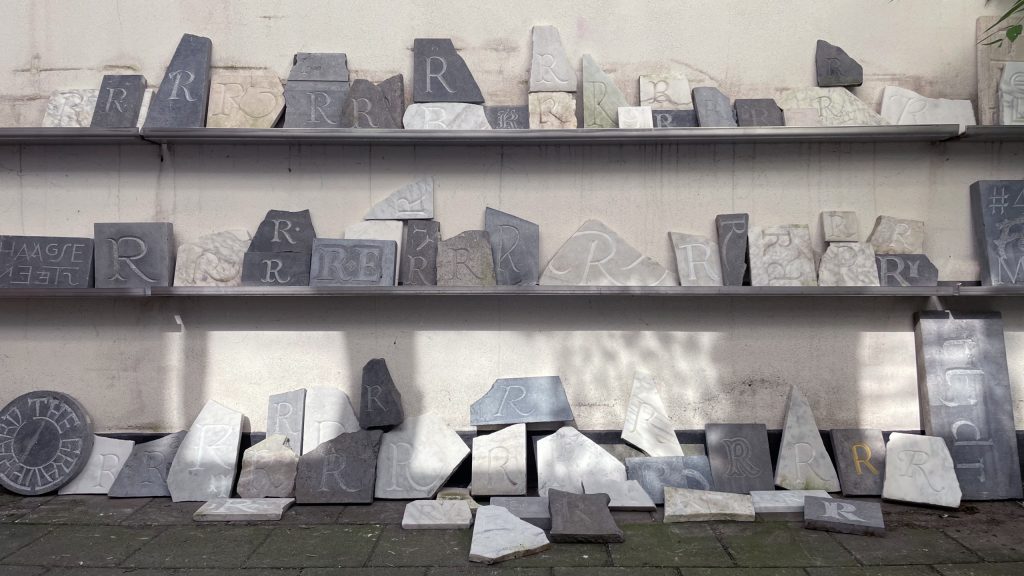
Through research into stone carving pedagogy, I identified a prevalent trend: the letter ‘R’ is frequently selected as the inaugural exercise for novices. This practice is notably visible in documentation from the Royal Academy of Art, The Hague (KABK), where workshop walls display a proliferation of student-carved ‘R’s.
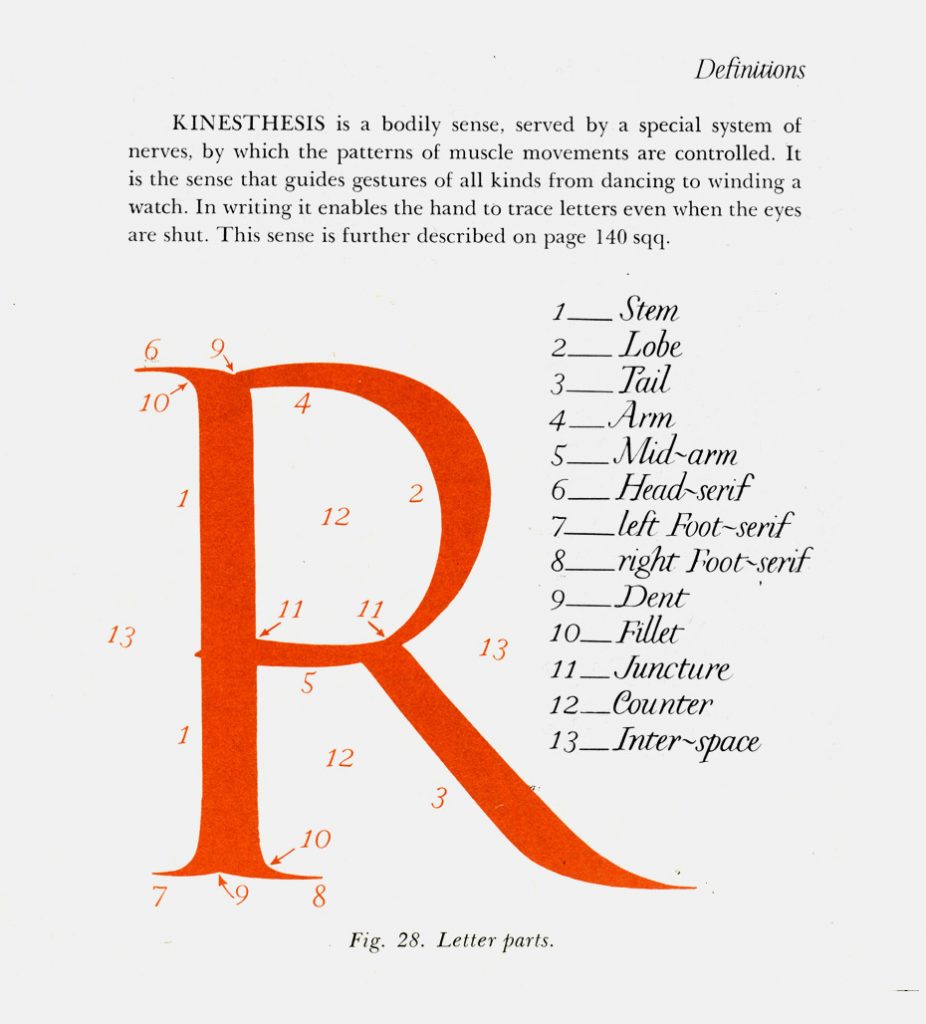
This pedagogical preference is theoretically grounded in Father Edward Catich’s The Origin of the Serif. Catich posits that the ‘R’ serves as the definitive technical assessment, acting as a morphological microcosm of the Latin alphabet. It synthesizes three distinct structural components: the vertical stem (akin to ‘I’), the curved bowl (as seen in ‘P’ or ‘B’), and the complex diagonal leg. Consequently, mastery of the ‘R’ implies a transferable proficiency applicable to the remainder of the alphabet.
The copy piece
Informed by this rationale, I resolved to center my initial enquiry on the letter ‘R’. However, distinguishing my approach from the traditional Roman style, I selected a specific Gothic ‘R’ located at St Mary the Virgin Church in Manchester. This selection was strategic; unlike Roman monumental capitals, Gothic script is fundamentally calligraphic in origin. It was conceived for the fluid dynamics of the quill pen rather than the rigid subtraction of the chisel.
Translating this form into stone necessitates the transposition of fluid, pen-based gestures into unyielding matter. This approach tries to critically examine the material tension inherent in preserving calligraphic nuance through the subtractive process of carving.
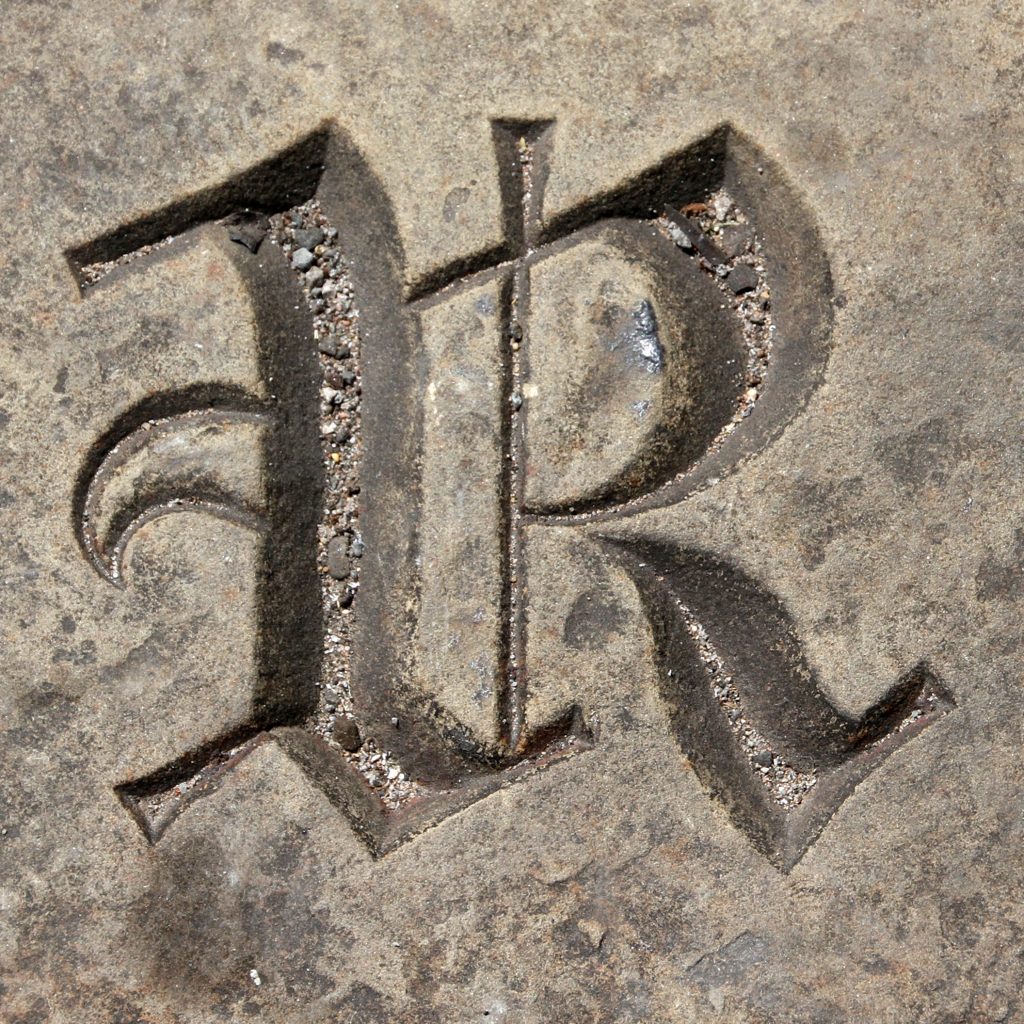
St Mary the Virgin
Photo taken by Leo Reynolds
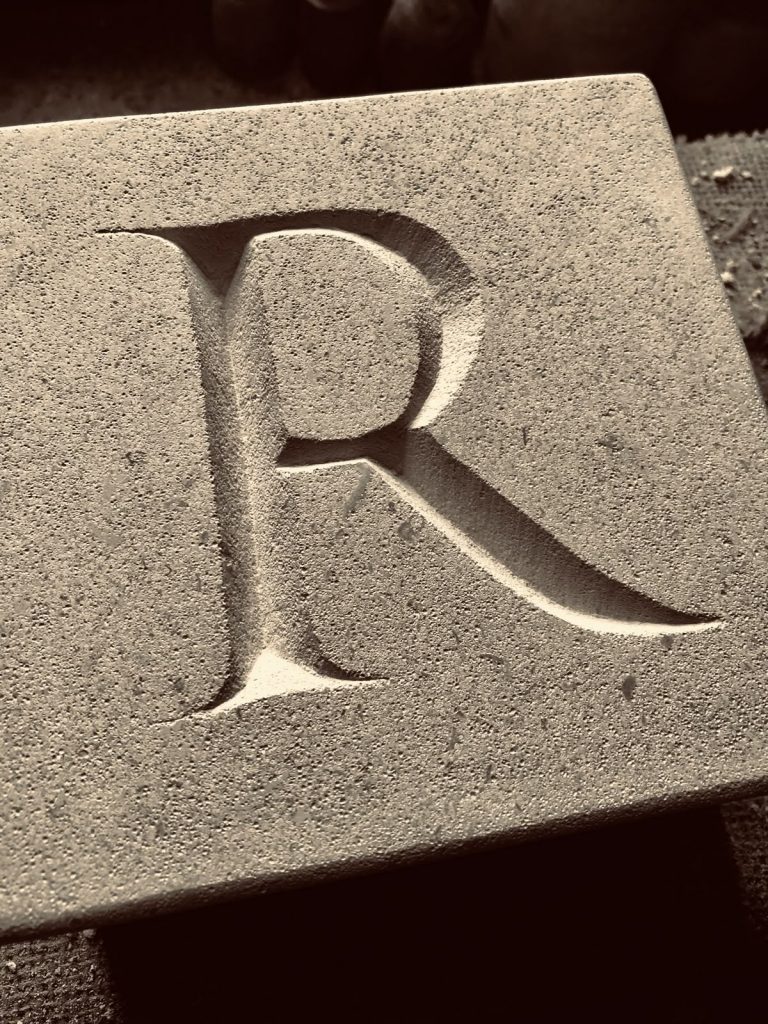
Carved by Andrew James
Bath stone
Exercise of the Trajan R
To replicate the intricate strokes of Gothic script, I chose to begin practising the most fundamental carving techniques with Trajan.
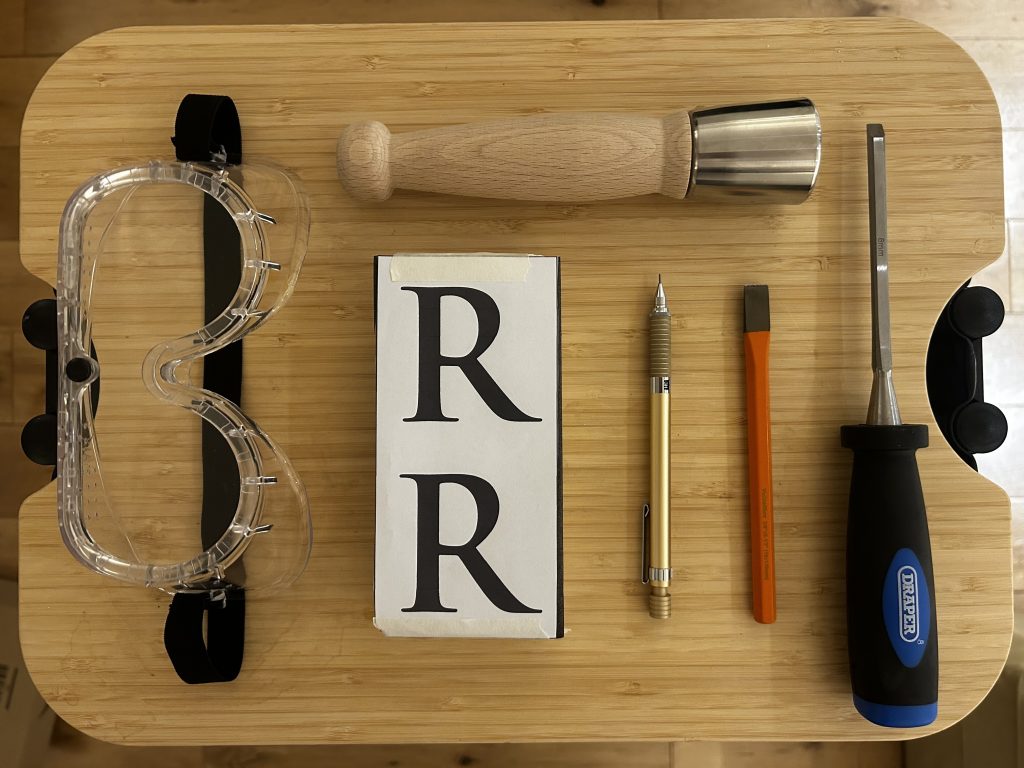
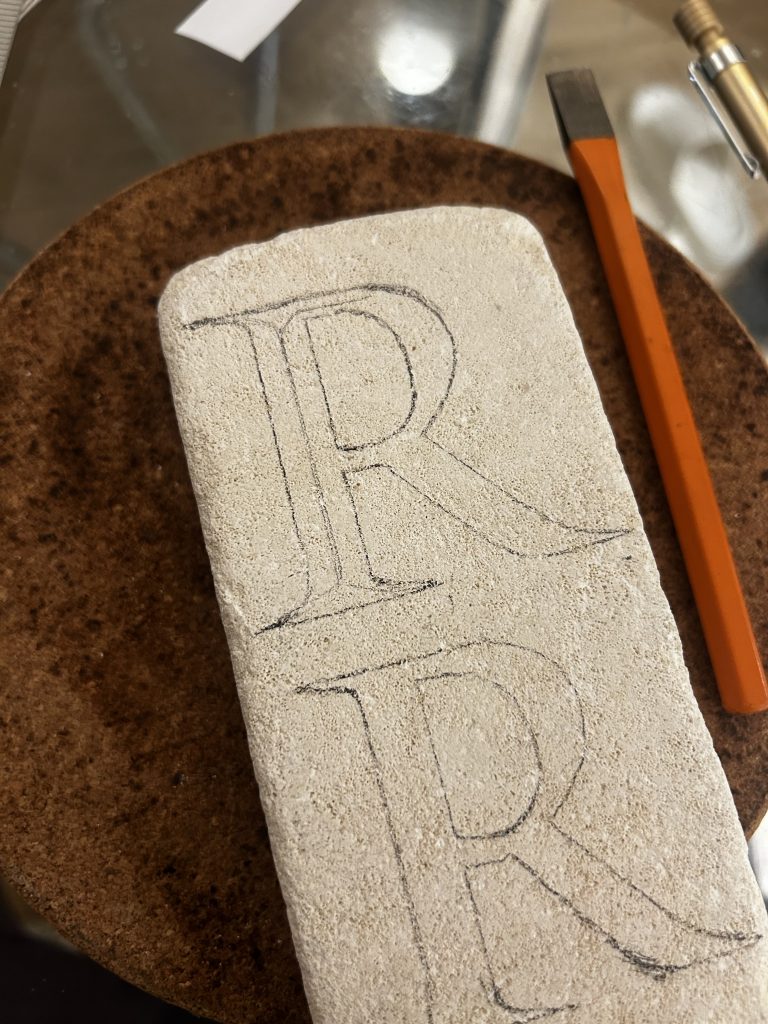
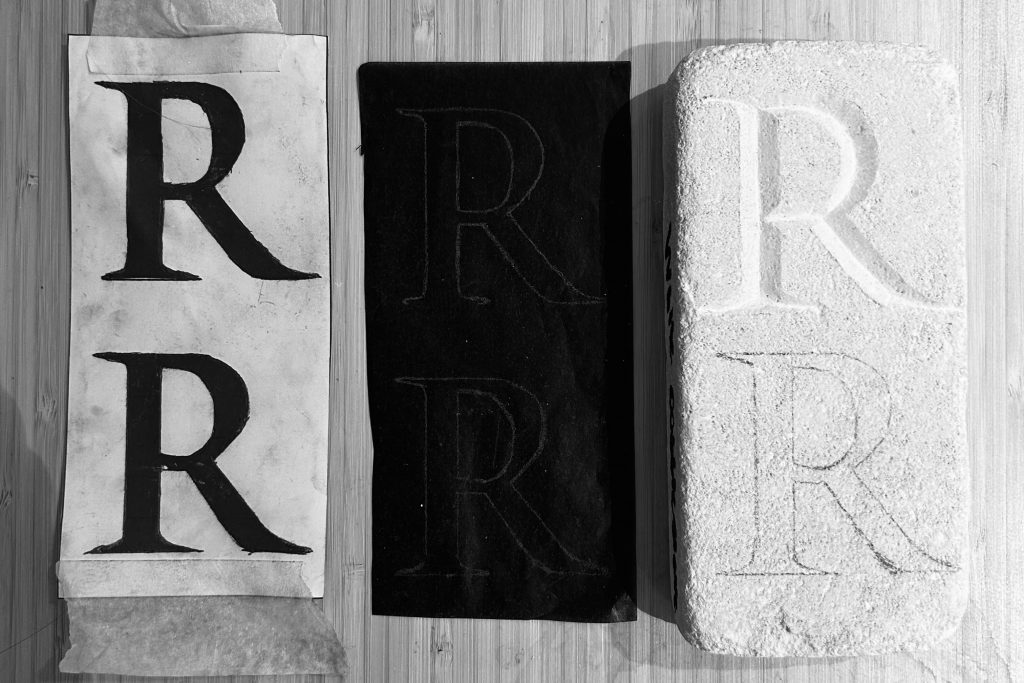
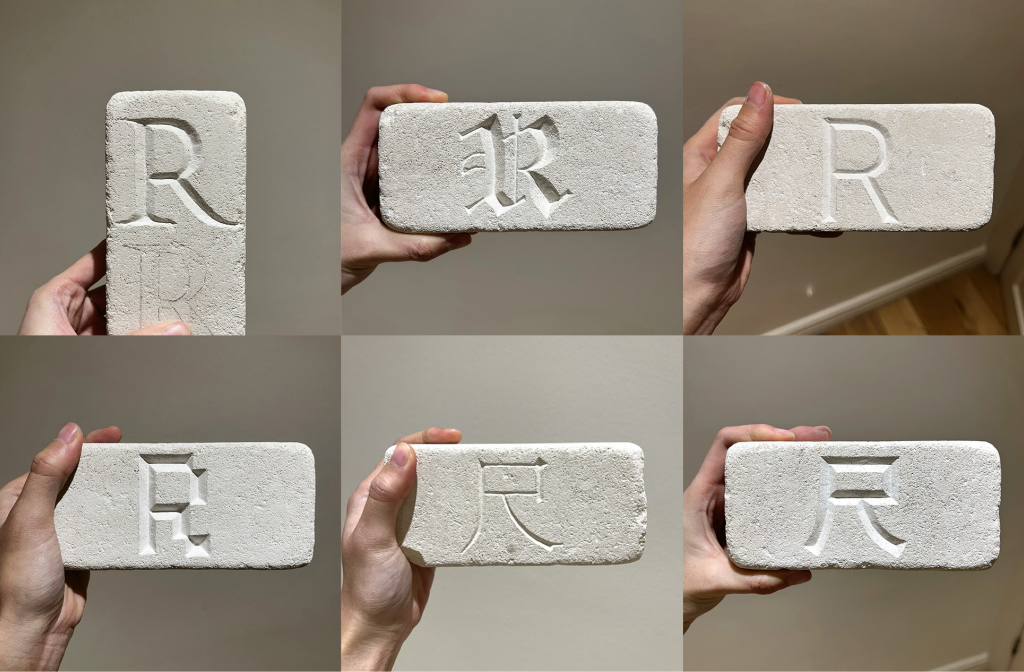
I traced the letter “R” from Trajan’s Column onto the limestone block using transfer paper and a pencil, and drew the centre lines of the strokes.
This was necessary because the carving would proceed from the central axis outwards towards both sides of each stroke.
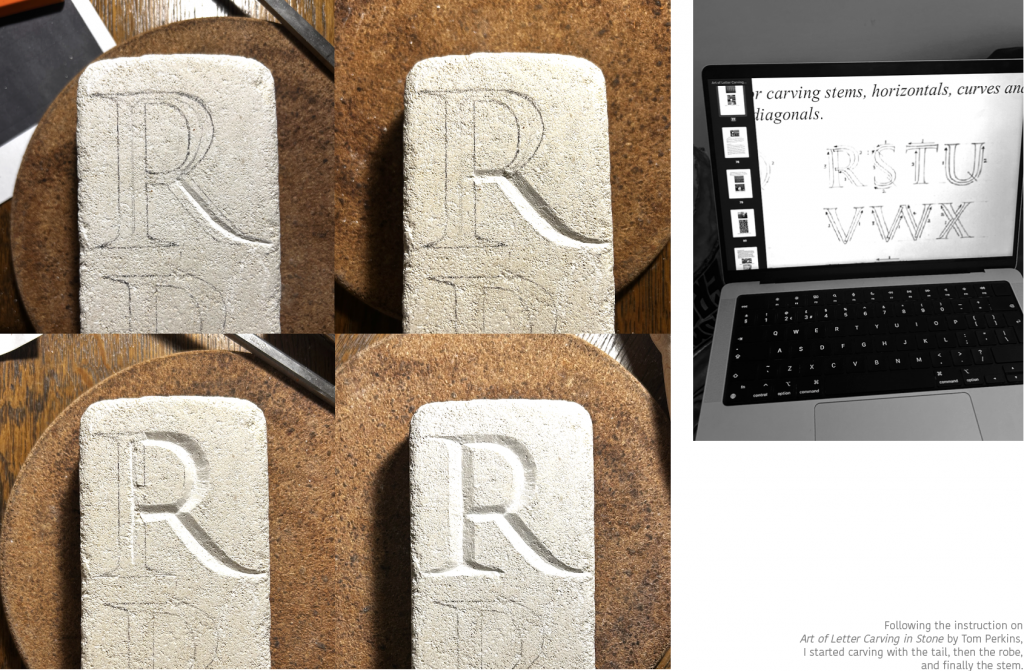
The Gothic R
I was unable to find the exact Gothic typeface that carved on St Virgin’s Church, so I reproduced it to transfer it on the brick.
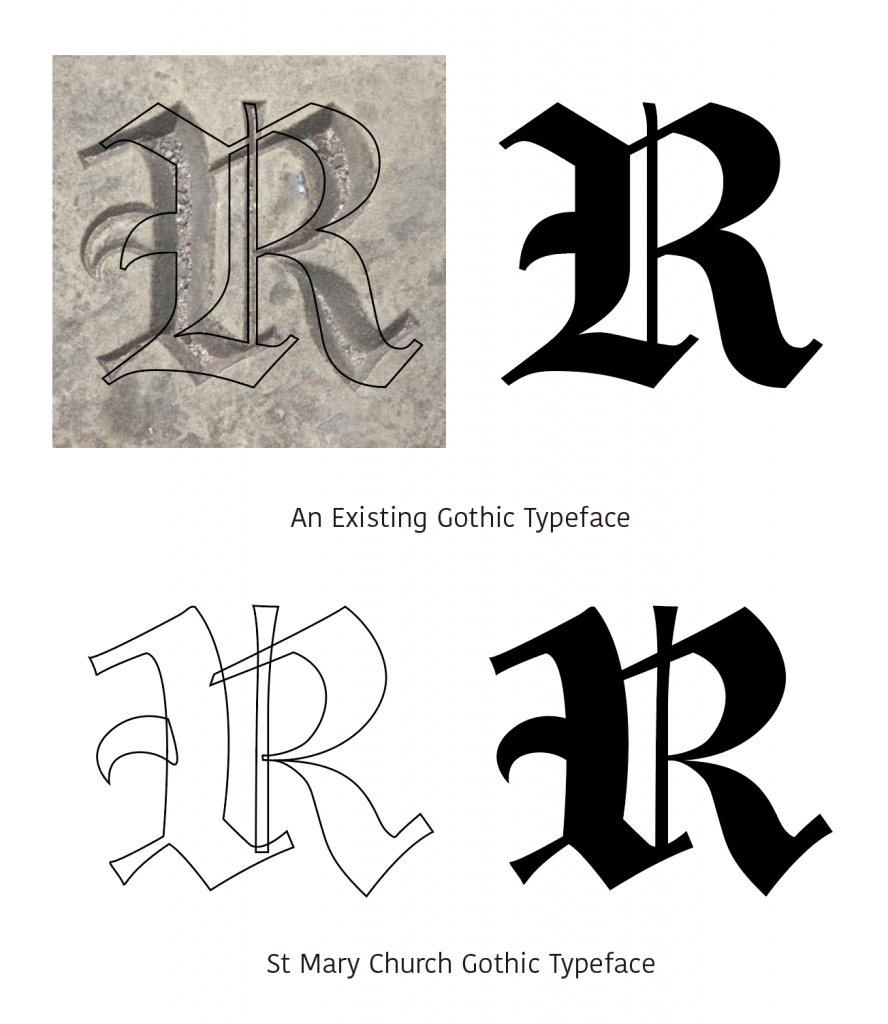
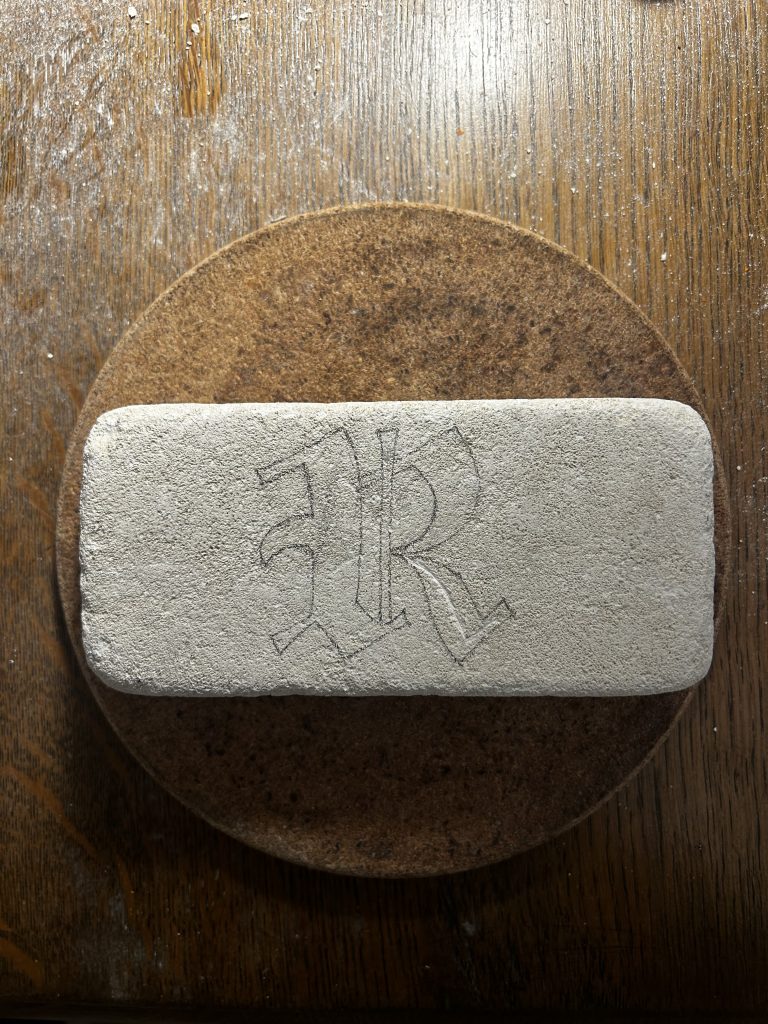
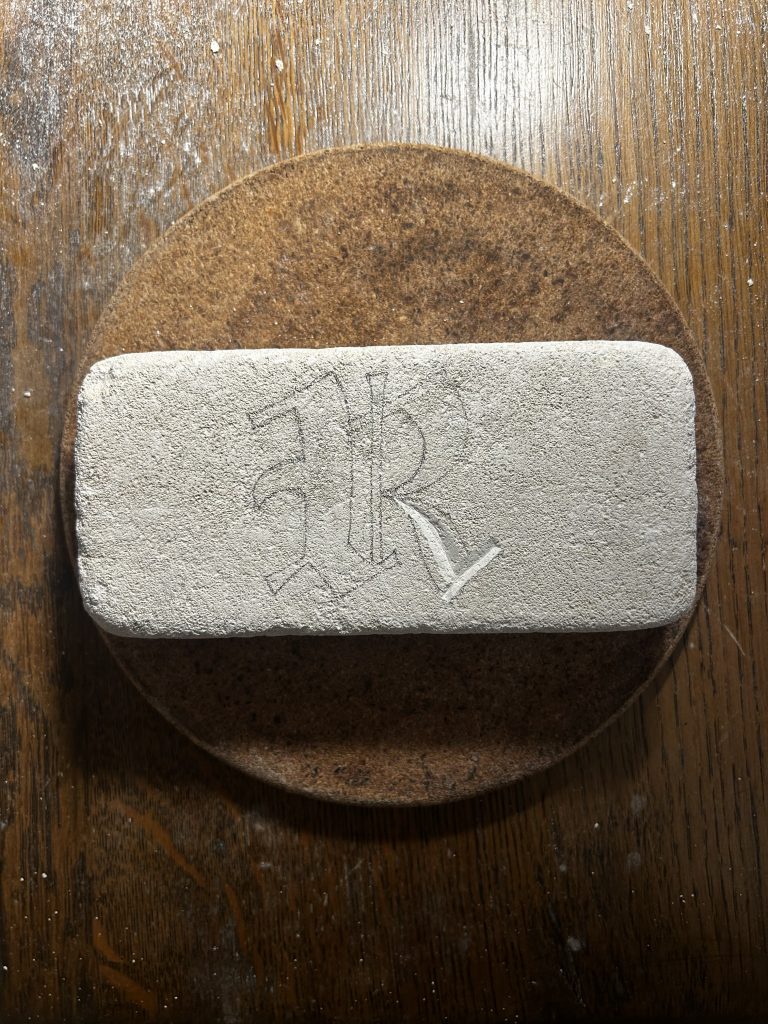
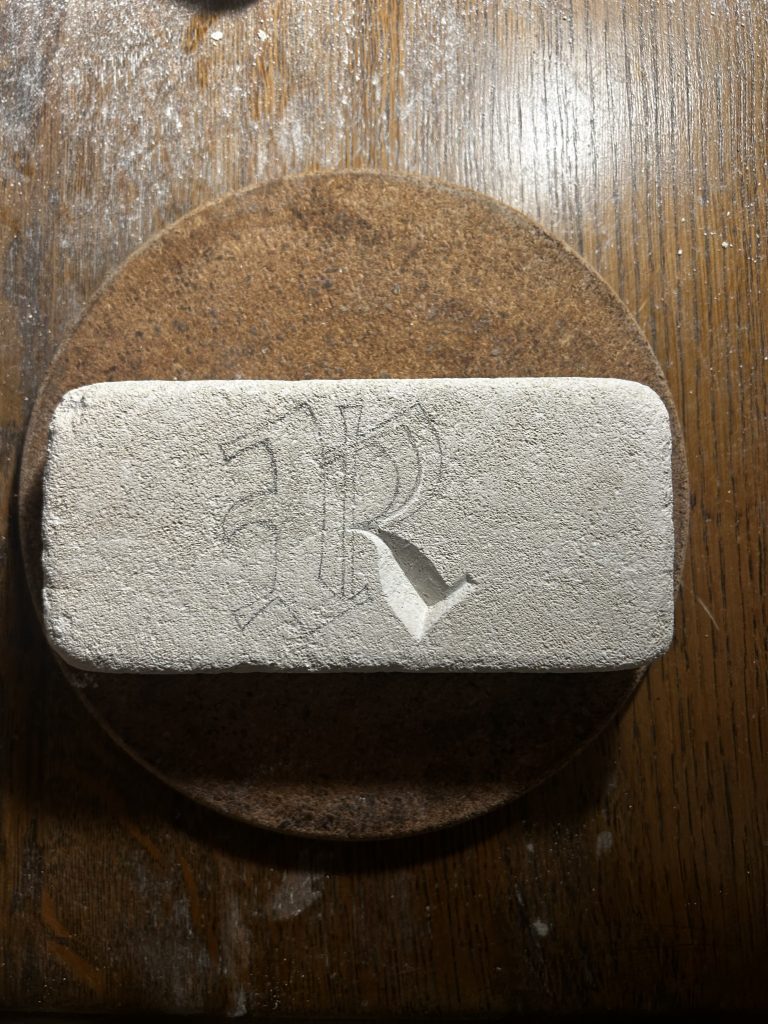
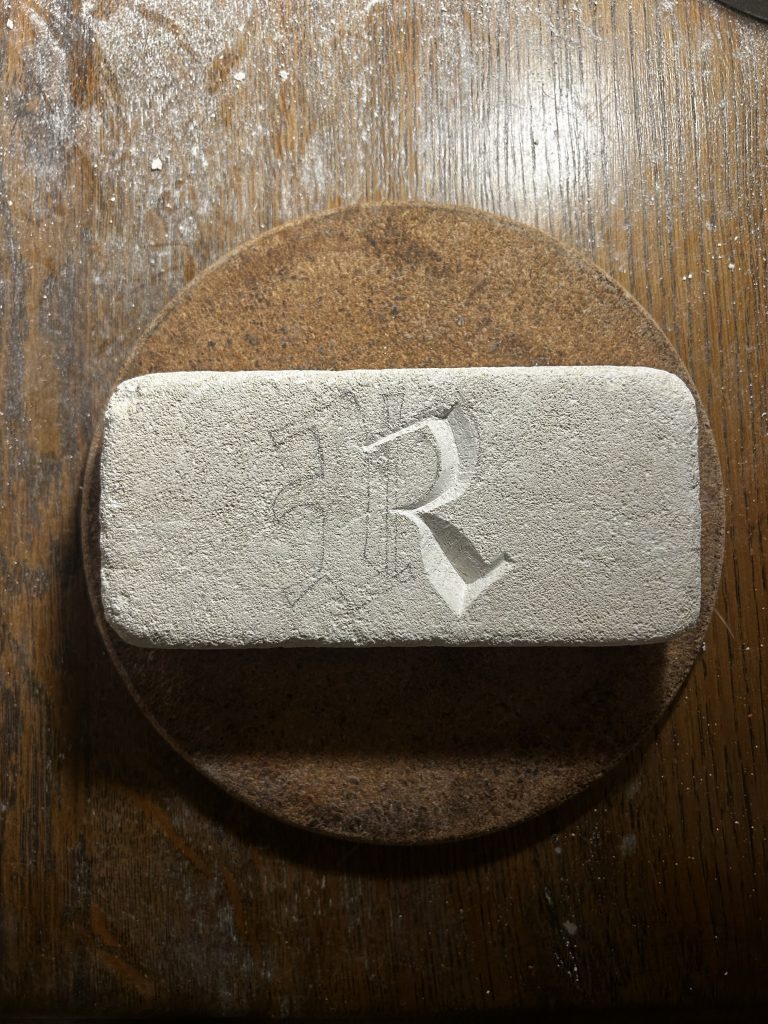
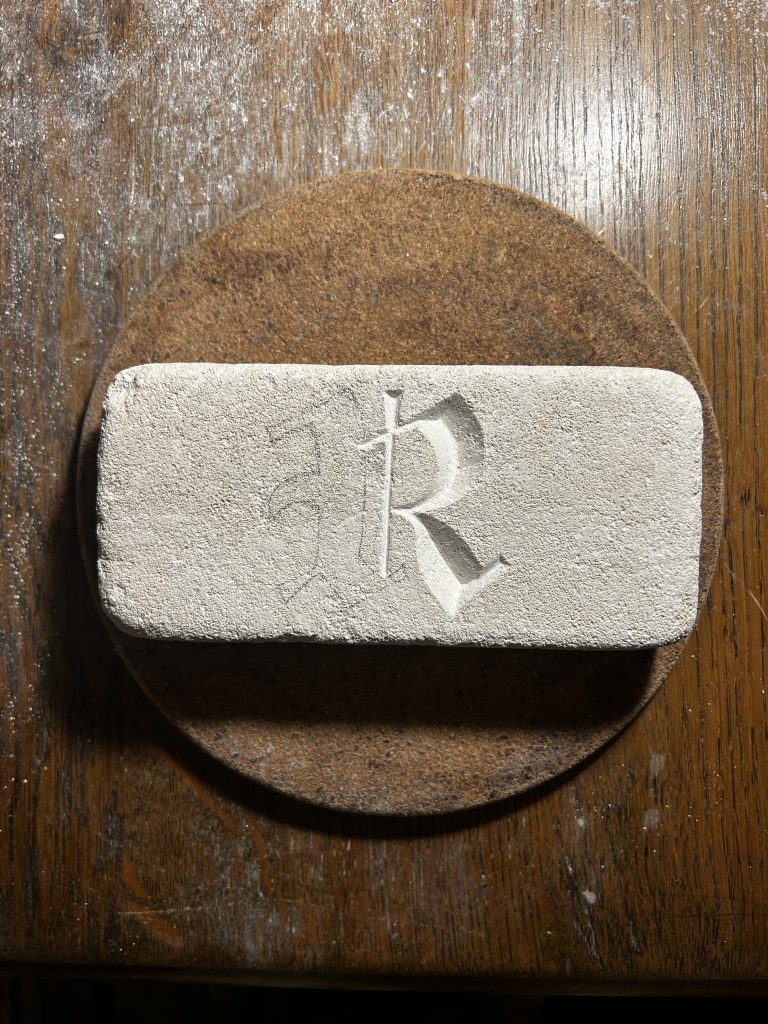
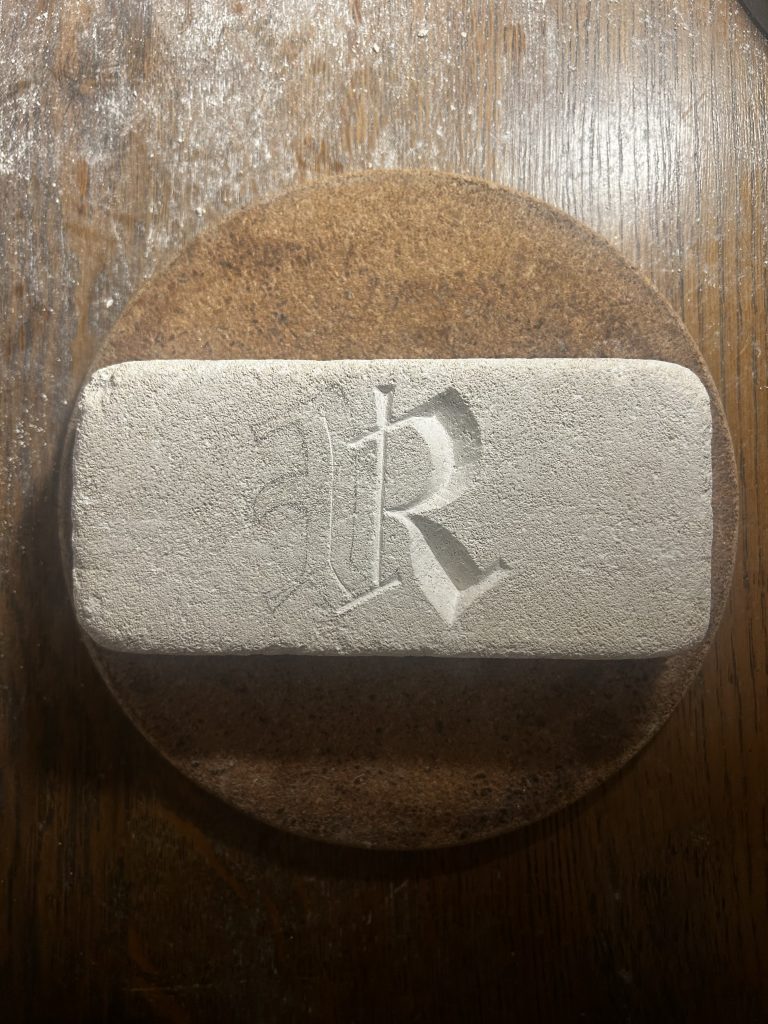
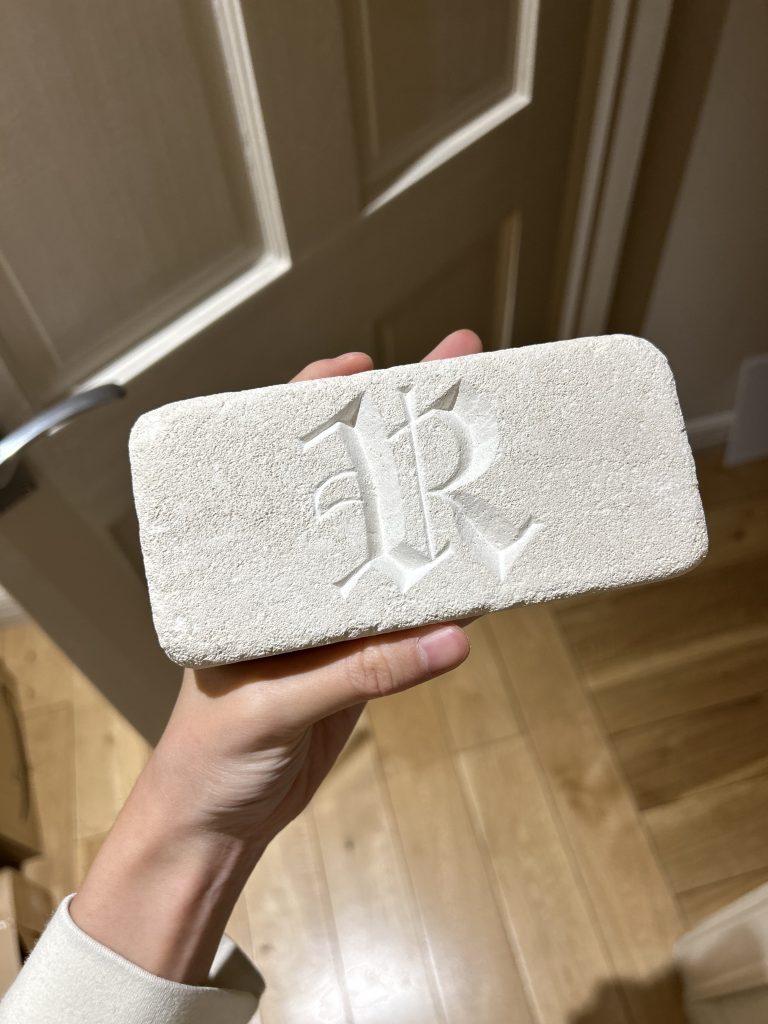
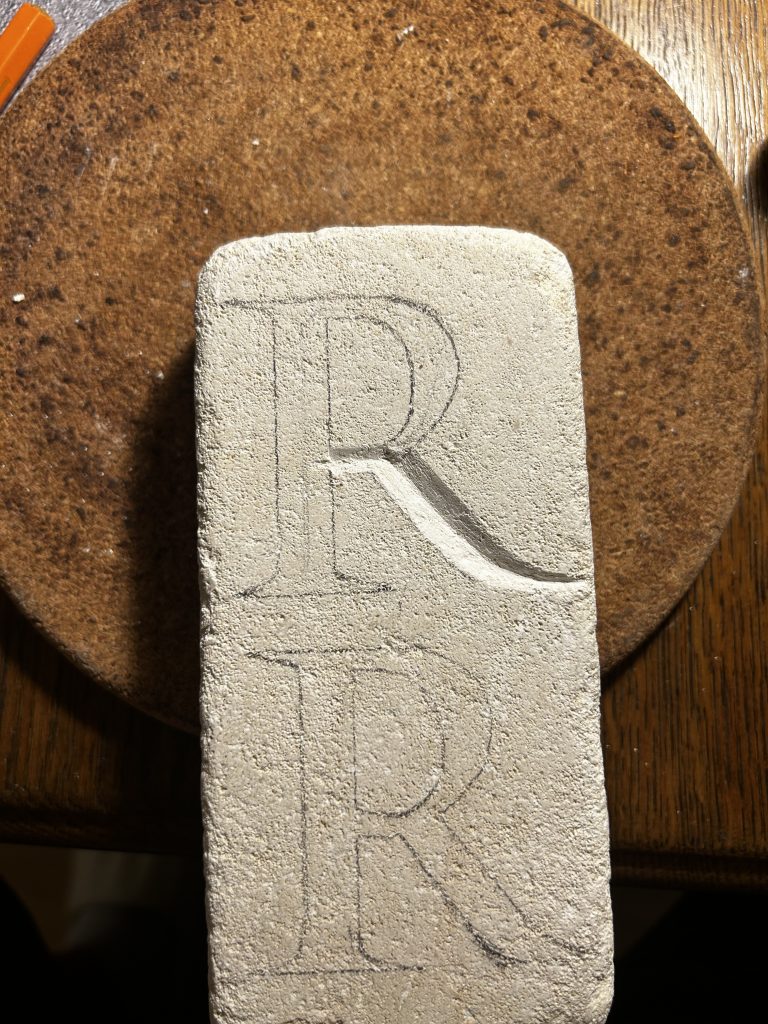
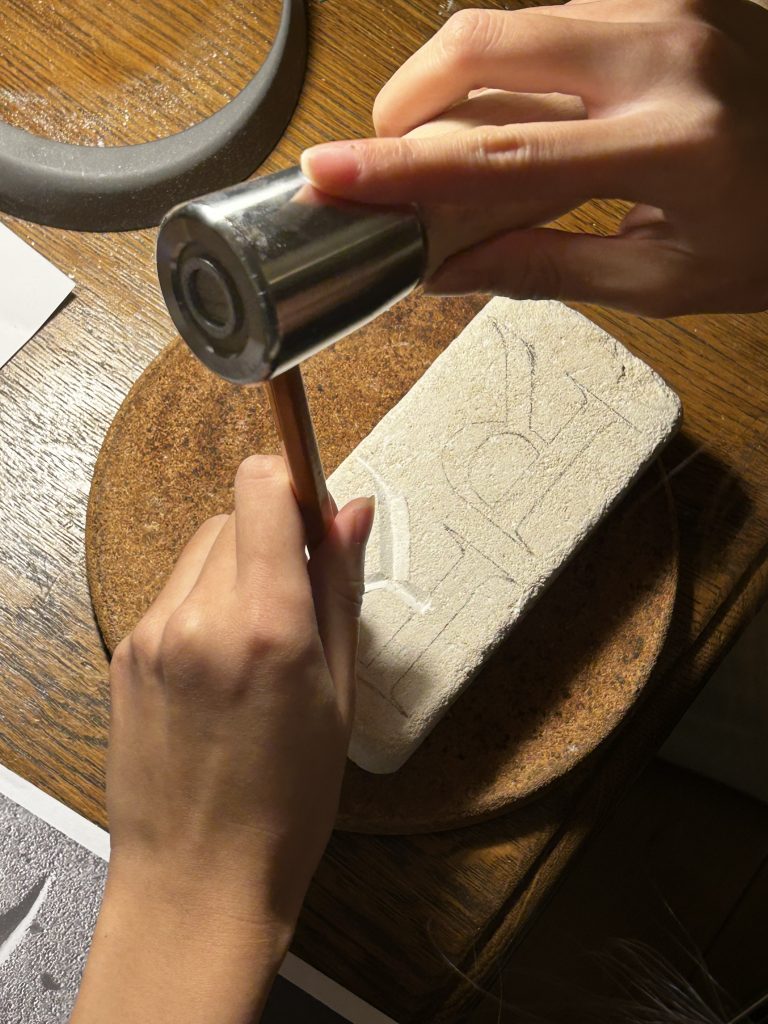
By moving from the ‘native’ Trajan to the calligraphic Gothic R, it uncovered the rigid constraints of the medium. I found that while Roman capitals flowed naturally from my chisel, the Gothic forms forced me into a tedious process of sculpting negative space. This experience redefined typography for me as the fossilized memory of the tool that created it, whether that tool is a chisel, a quill, or any software.
Second Week’s Tutorial
Sharing my stone carving results with the group and Zarna elicited some unexpected reactions. They were surprised that instructional manuals for stone letter carving even exist. Interestingly, we discussed how these pedagogical resources seem exclusively dedicated to Roman Serif capitals. When asked if a Gothic guide existed, I confirmed it didn’t. In its absence, I appropriated the Trajan stroke order, specifically the bottom-up sequence (Tail → Lobe → Stem). This logic proved effective; it naturally accommodated the wrist’s torque, allowing for smoother execution of the curves.
While the feedback regarding content and linguistic bias was valid, Zarna’s advice to ‘keep constants’ resonated most deeply. It connects directly to our understanding of Conditional Design: randomness is not about abandoning control or allowing arbitrary outcomes, but rather defining the specific scope in which variation occurs. This insight compels me to approach next week’s iterations with a much more rigorous framework.
Hacking into digital era
Defining ‘hacking’ as the imposition of modern, sans-serif logic onto a classical material, I chose Roboto and the pixel font LoRes to explore how the stone reacts to these foreign, screen-born aesthetics.
Roboto
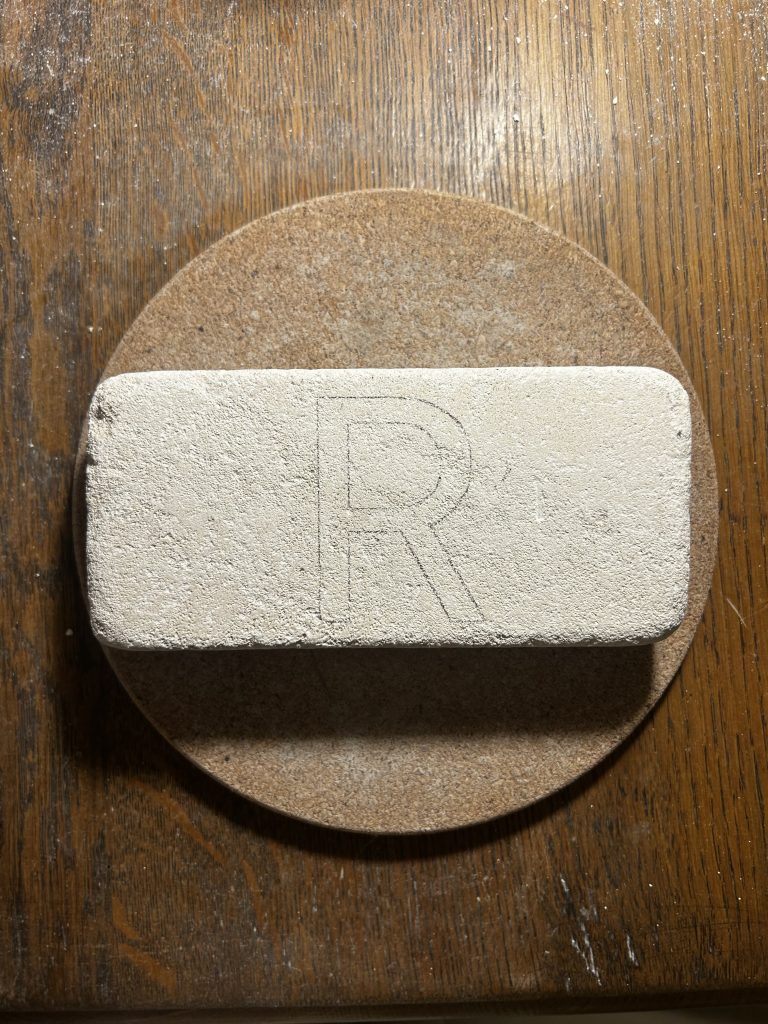
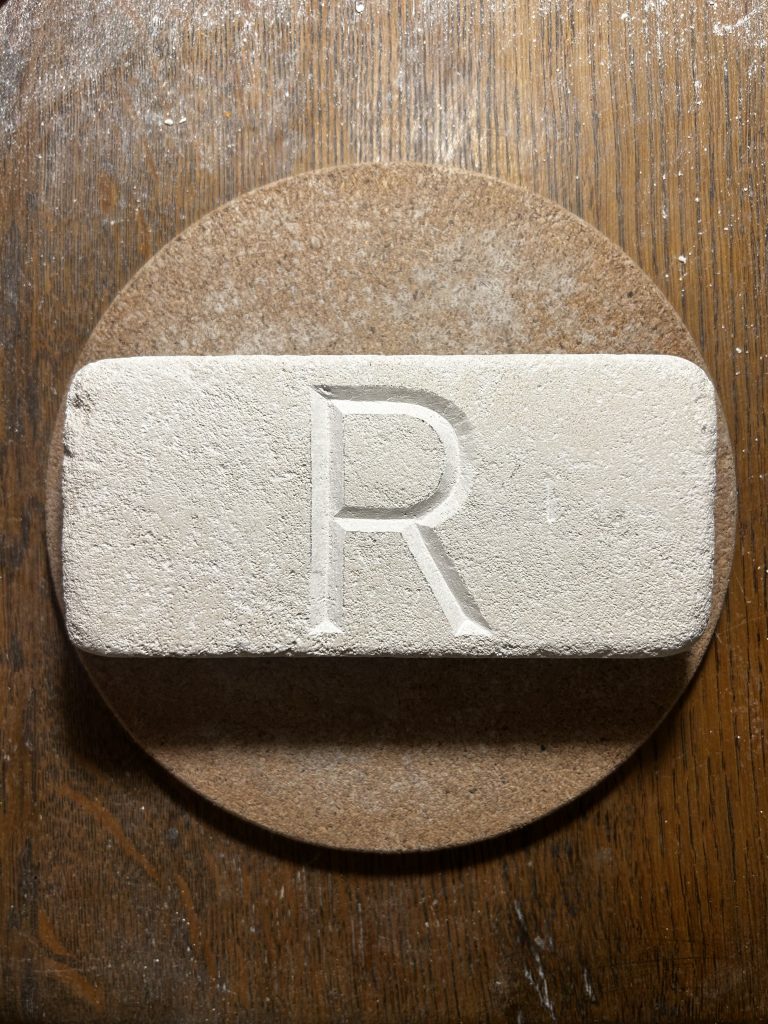
When carving Roboto, I noticed it somewhat resembles Trajan without serifs or tail curves, and their stroke weights are quite similar.
However, the absence of serifs makes this a more challenging font to carve. Without serifs to provide turning points for the chisel at stroke junctions, I must refrain from carving strokes to their full extent at these points. Only after the subsequent stroke is carved can I gradually chisel out the precise shape of that corner.
LoRes
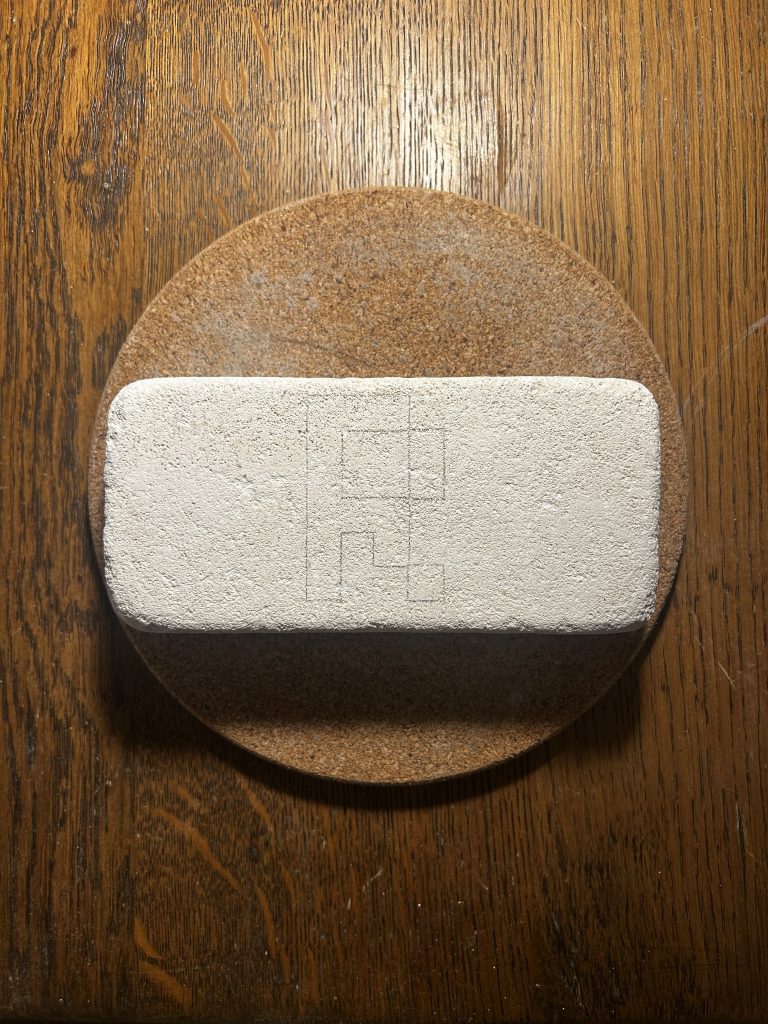
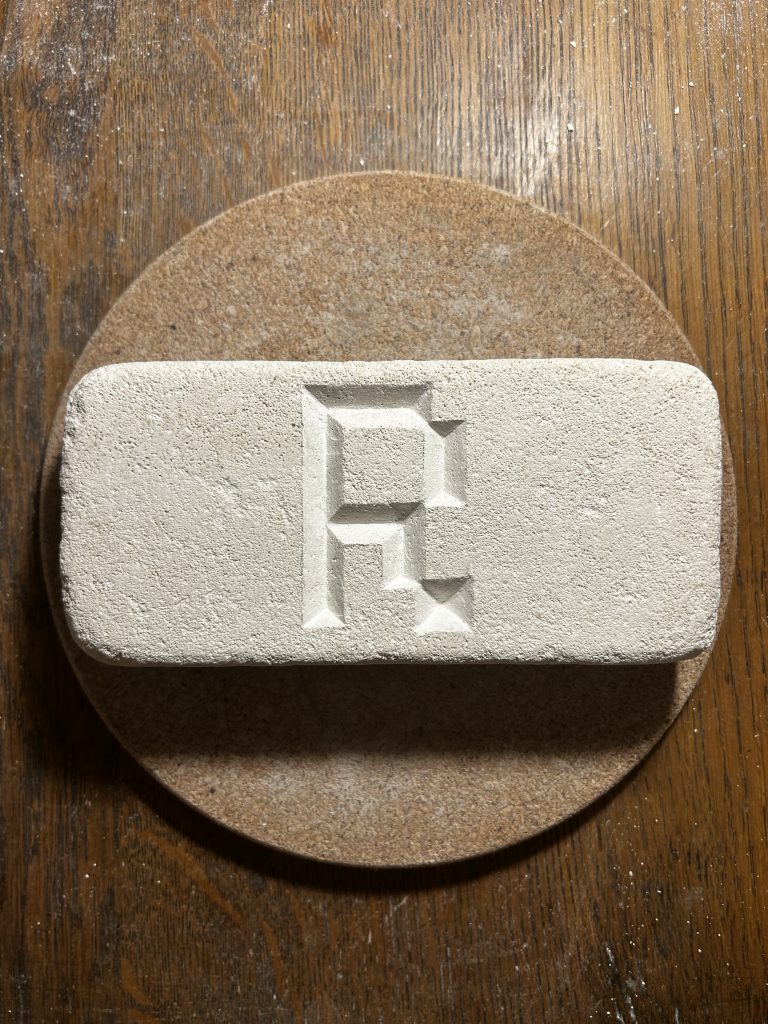
I never imagined carving pixel fonts would prove the most challenging. I had underestimated the difficulty of it because pixelated font contains no curves at all. Yet this very feature became an obstacle to smooth carving, I had to constantly keep my left wrist (the hand holding the chisel) completely still while my right hand continuously struck the chisel with the hammer.
Simultaneously, the isolated square in the lower right corner of this pixel font proved the most challenging structure I’ve ever carved. With no reference materials to guide me on how to handle it, I could only guess with the chisel, carving outwards from the center of the square. After carving, this block originally 9.5mm wide, ended up 11mm wide.
Carving Chinese characters
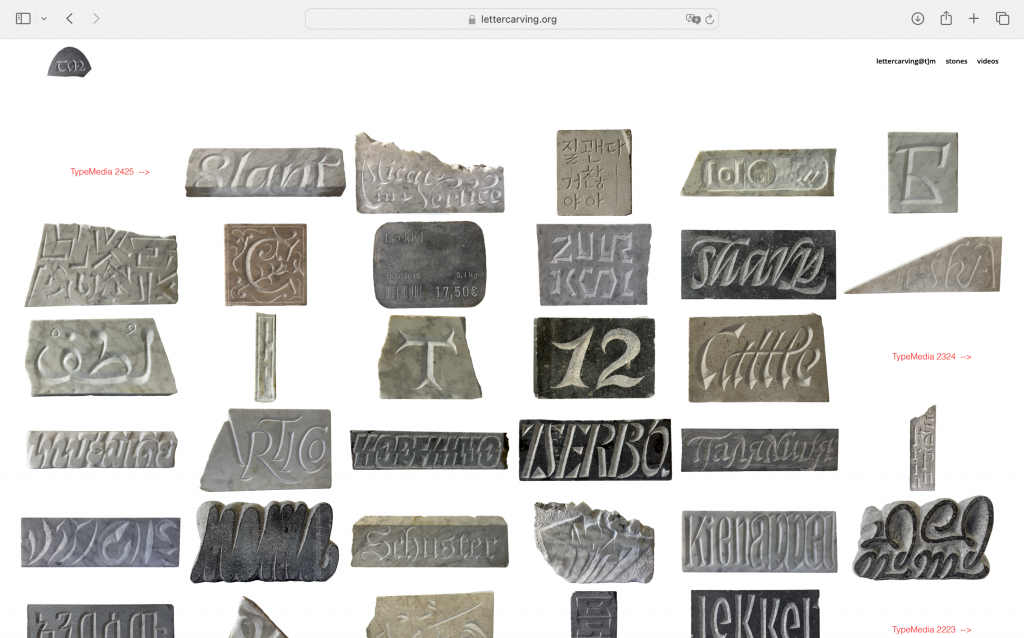
While conceptualizing the iteration plan, I revisited the KABK stone carving workshop website and noticed that many students carved not only English but also other languages. For instance, this image shows Korean, Arabic, numbers, and even emojis. This inspired me to carve Chinese characters next.
R & 尺
Compared to frequently hand-writing English, I’ve almost lost the habit of writing Chinese characters. Rediscovering the act of ‘writing’ Chinese through stone carving might be a unique opportunity. Moreover, exploring how stone carving evokes different experiences for carvers across various languages excites me greatly.
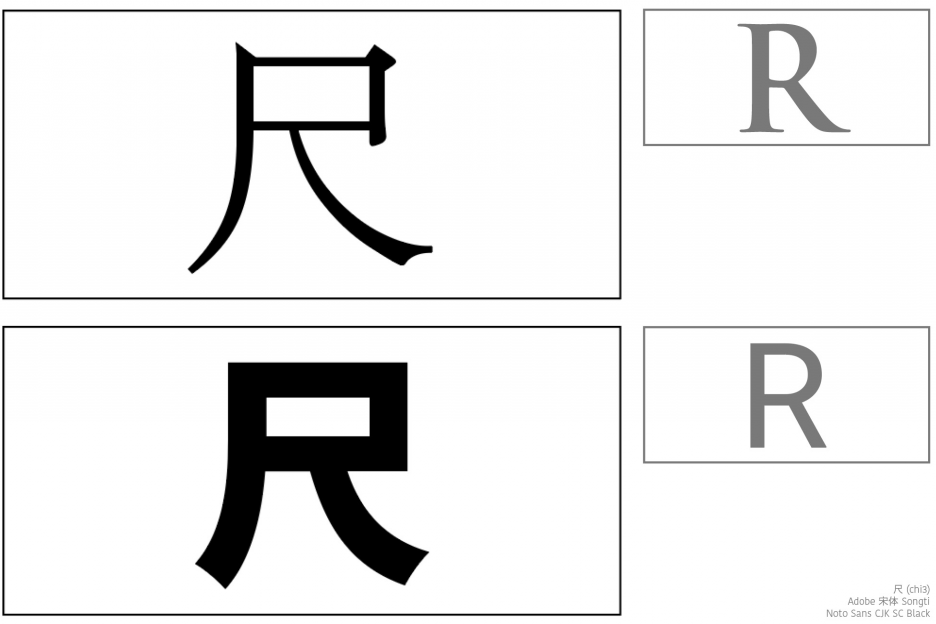
I’m thrilled by this coincidence—in Chinese characters, ‘尺’ (Chi3) bears a striking resemblance to the letter R. This character means “ruler.” I selected Songti (宋体) and Noto Sans (a sans-serif font) as counterparts to Trajan and Roboto.
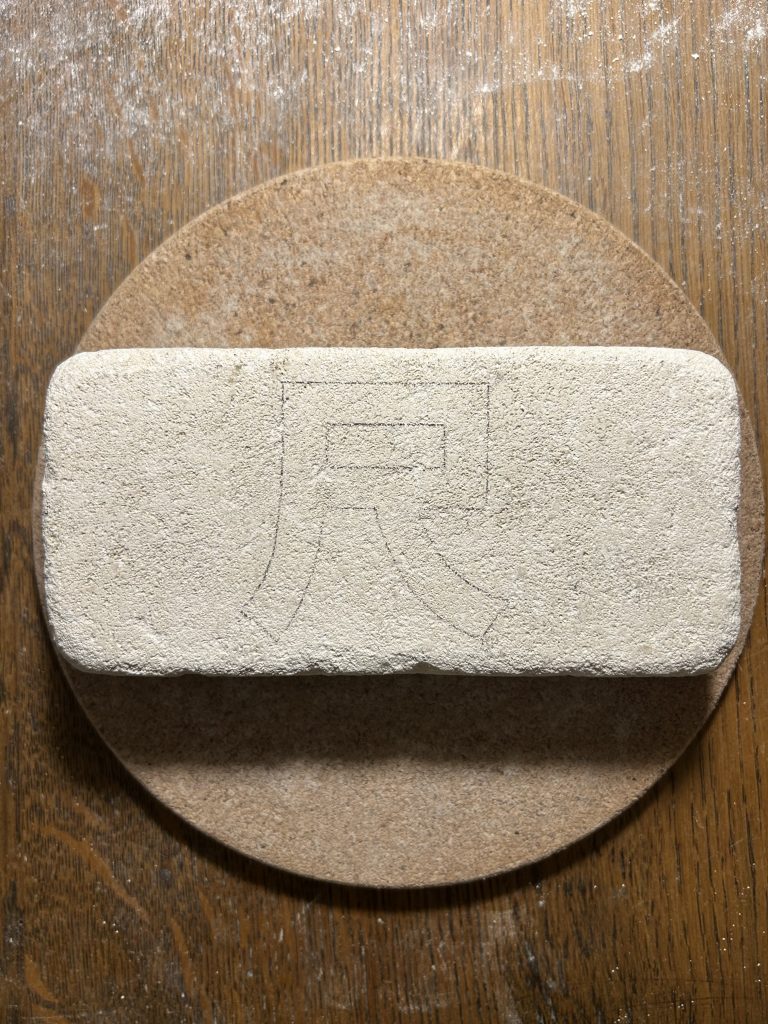
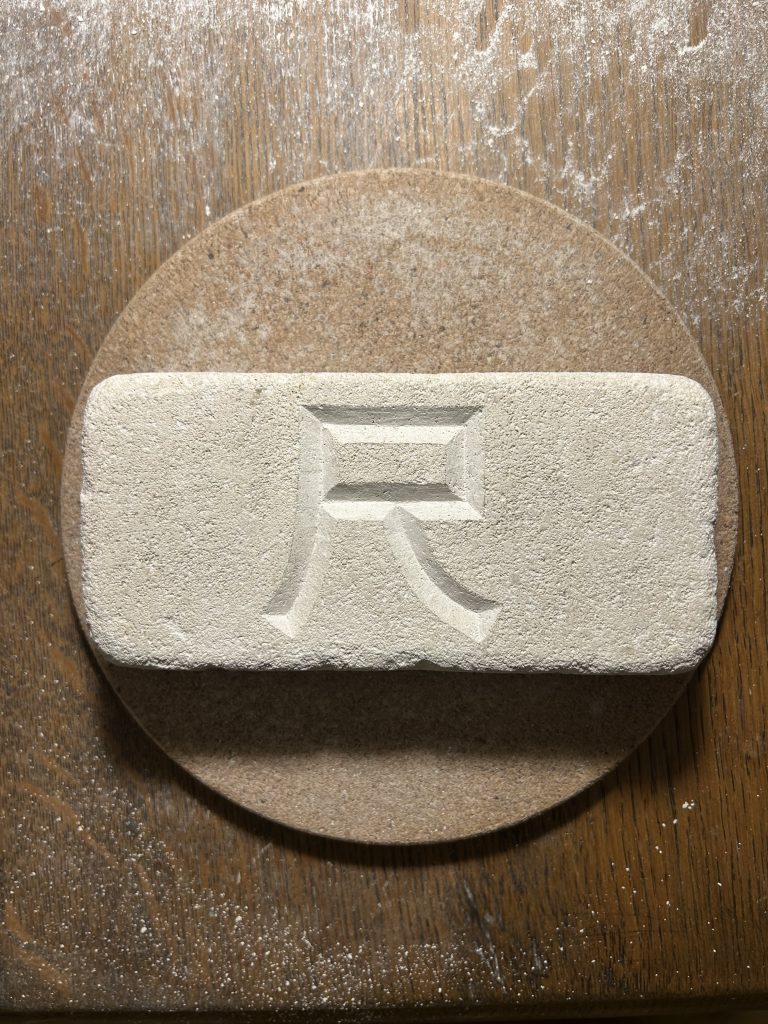
I assumed that carving the sans-serif character 尺 would feel more like carving Roboto, but it reminded me more of carving the LorRes. The broad strokes demanded just as much force and time to carve out.
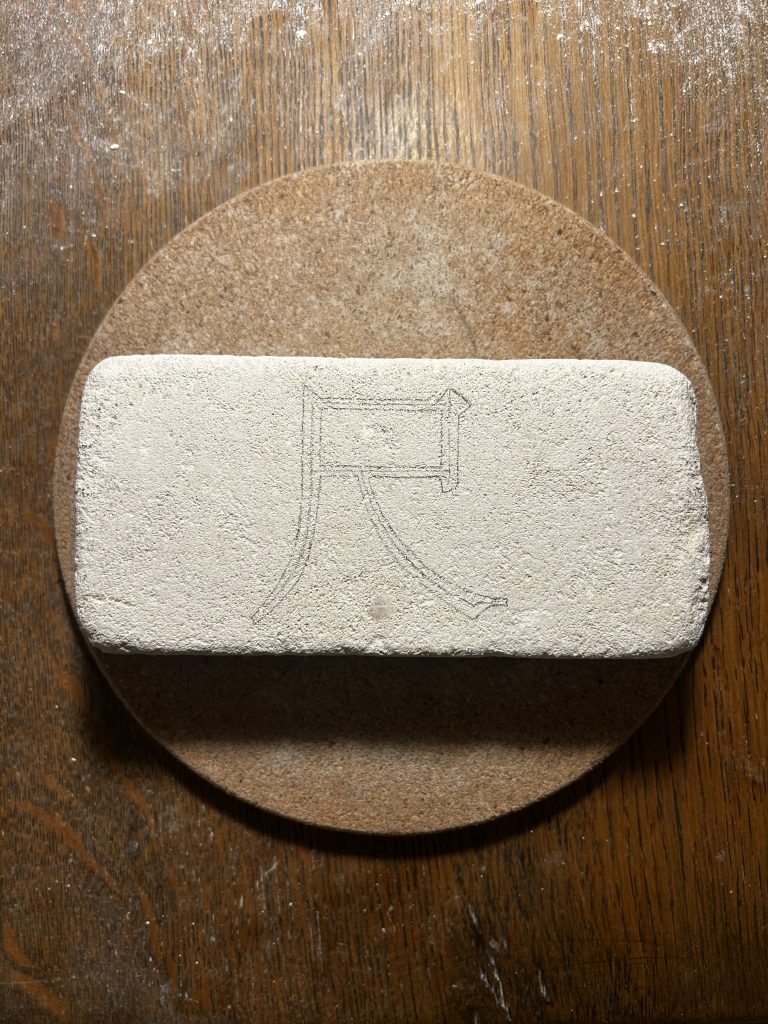
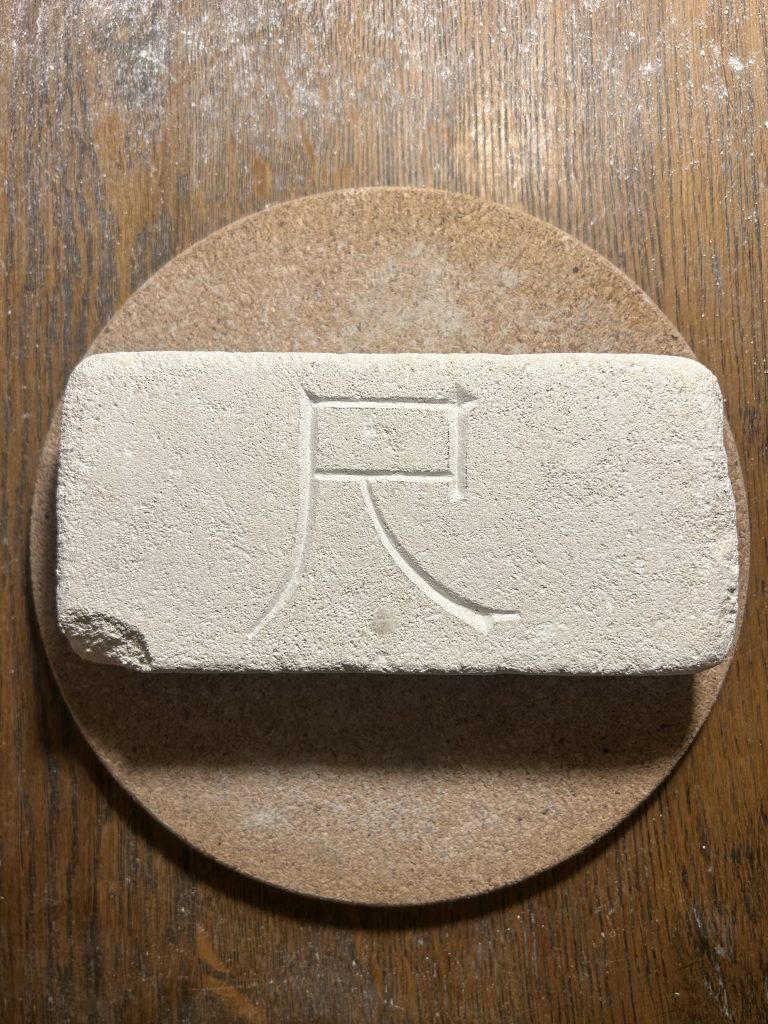
As I carved this final character, I was struck by how consistently stone carving transcends linguistic boundaries. When strokes were thick, I had to apply more force to carve them deeper; when strokes curved, my wrist had to follow the curve’s curvature; and serifs were always easier and simpler to carve than sans-serif characters.
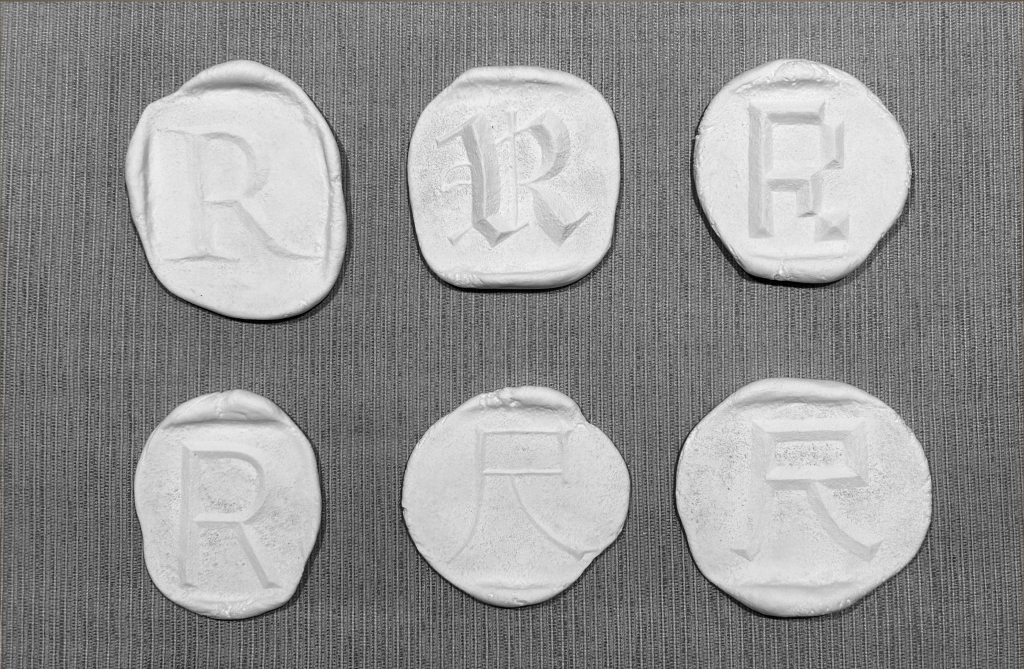
3 Similar carving structures between 尺 & R
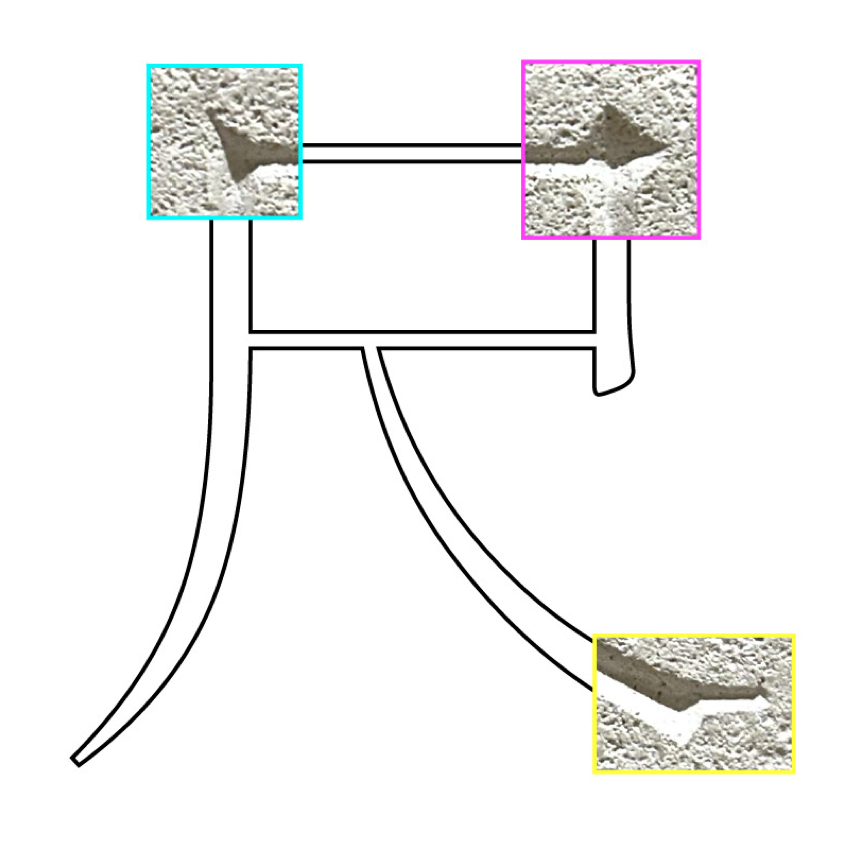
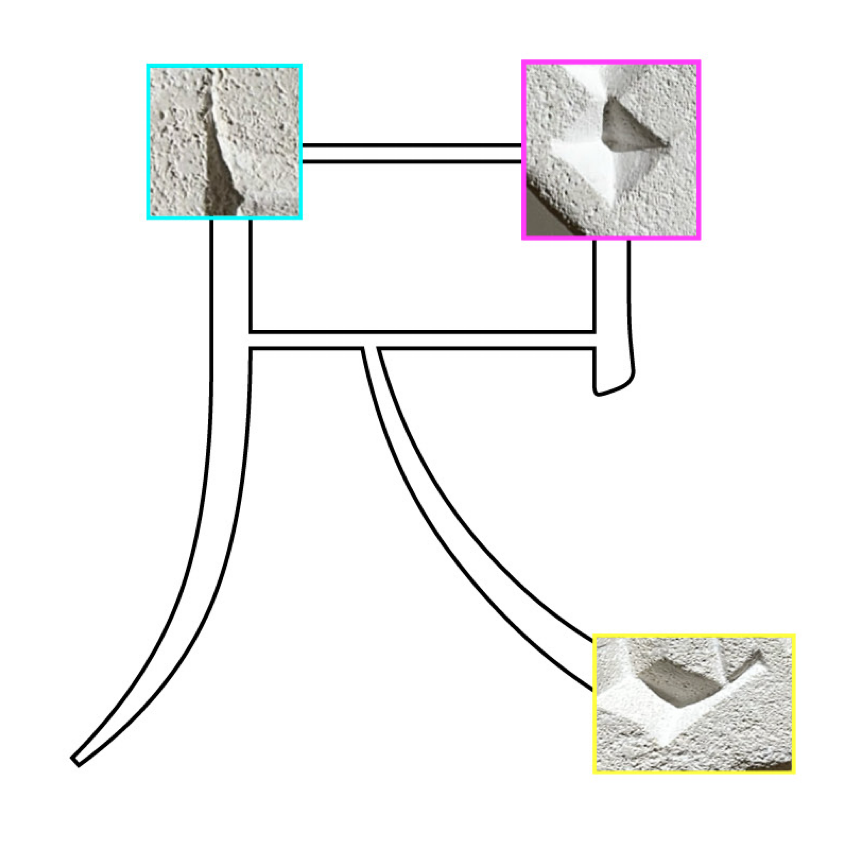
The left side shows the original structure of 尺 on the stone carving
The right side shows 尺 replaced with the structures that similar to R
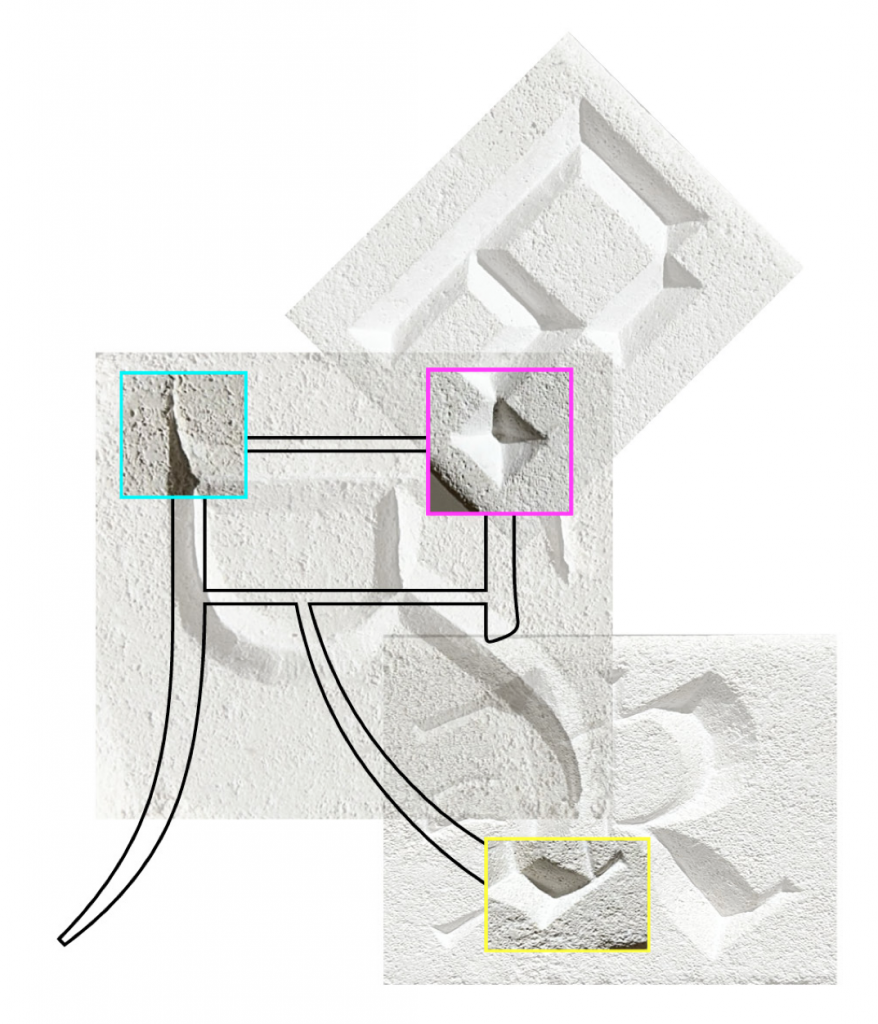
The Pyramidal Cut
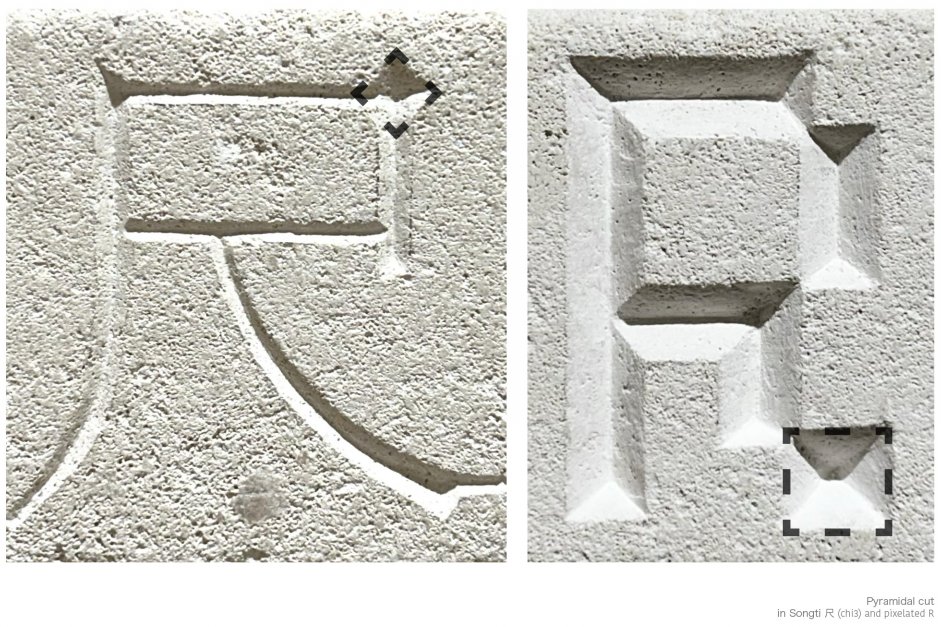
In the magenta section of the preceding comparison image—the area outlined by the black dashed line in the figure above—a striking similarity emerges. One is a serif Chinese character, while the other is a pixel-based English letter. In this structure, both required me to drive the chisel’s point vertically into the surface. Upon researching, I discovered this carving technique is termed as pyramidal cut within the Western stone carving context.
This term recalls my experience in Dendera Temple of Hathor, Egypt, where I observed how the ancient Egyptians inscribed hieroglyphics upon the stone walls, columns, and even ceilings, affirming stone carving as a timeless universal vessel for language.
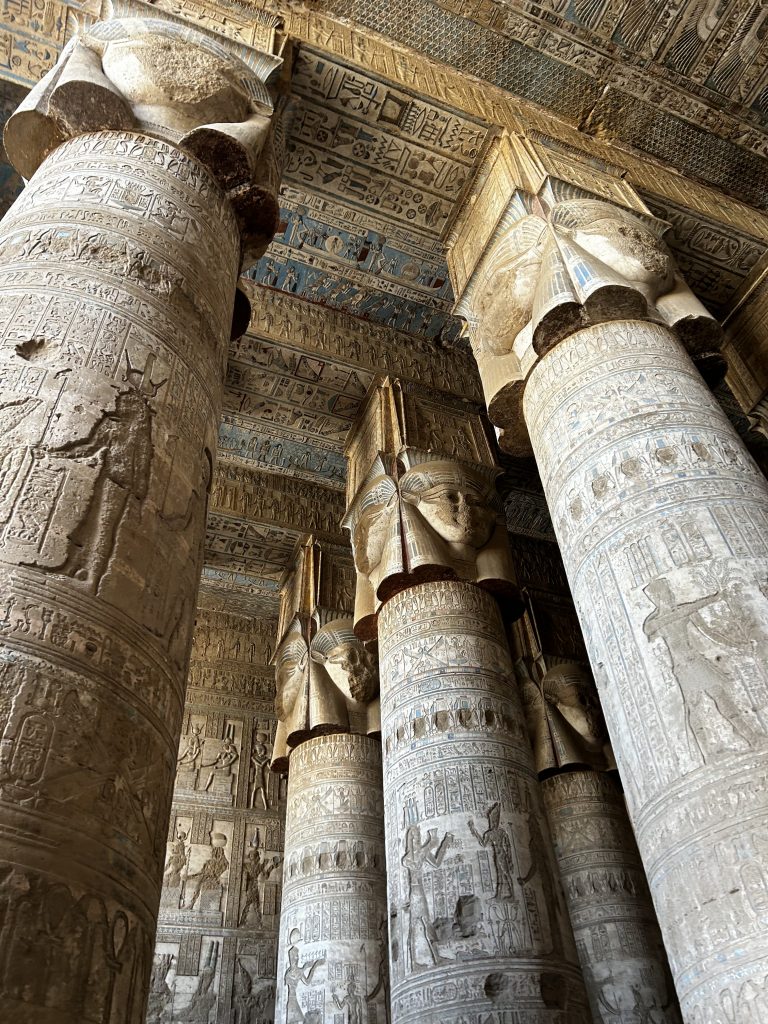
Stone carving demands a specific kinetic response to every structural problem, regardless of whether the form originates from the fluidity of paper, the grain of the woodblock, the primordial nature of stone, or the rigid grid of the screen.
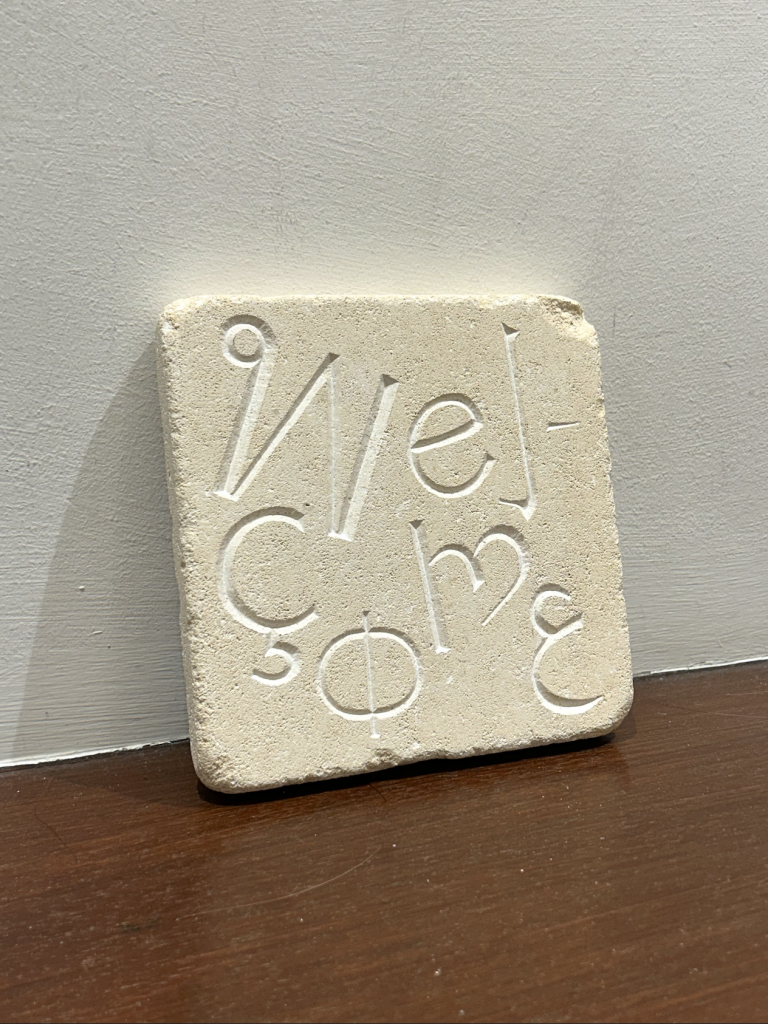
It is this structural homology that I aim to visualize in a single, unified stone carving. At the same time, I am intrigued by how the chisel interacts with scripts that are foreign to me. While I have examined countless inscriptions dedicated to single languages, the Rosetta Stone remains the singular historical precedent that forcibly juxtaposes distinct writing systems onto a shared material plane.
Welcome
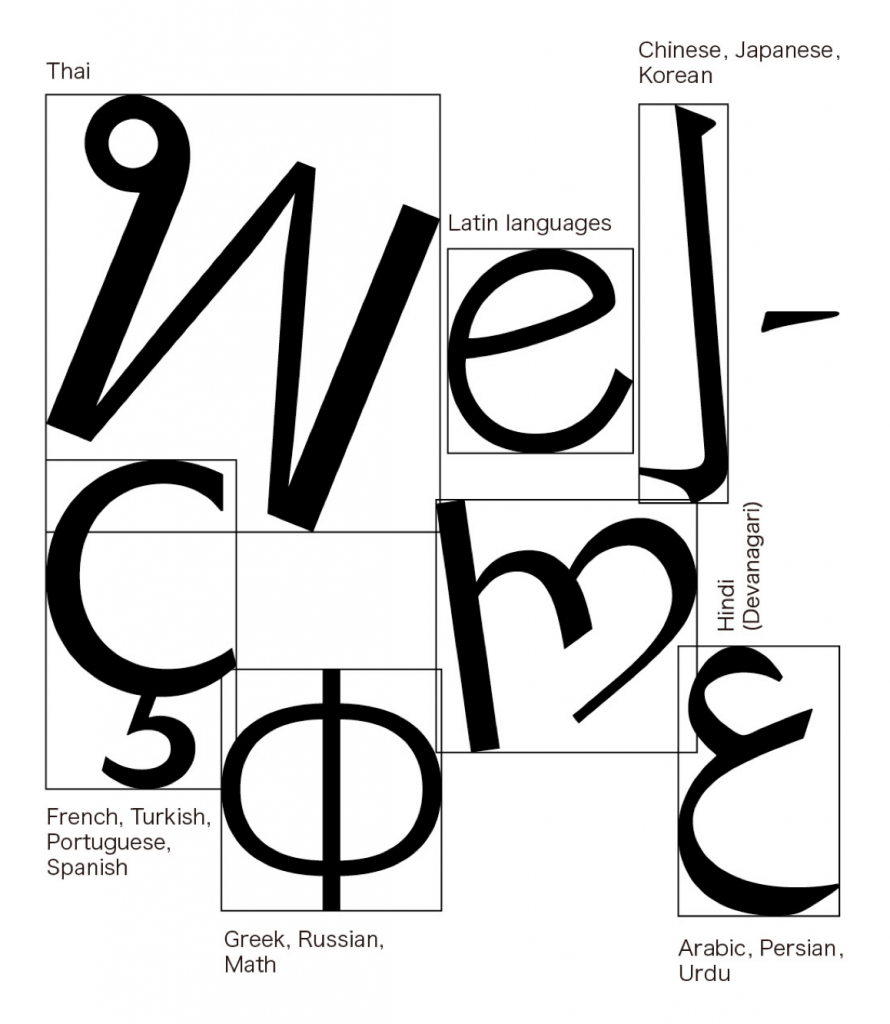
When choosing the word, ‘Welcome’ instantly came to mind. It captures exactly how I felt about the craft: stone carving felt like an invitation to me, and essentially, an invitation to everyone.
For the composition of the word, I chose languages that are personal to me, mixed with the languages spoken by my immediate circle of friends and peers.
Leave a Reply